Whitewater Paddle Board
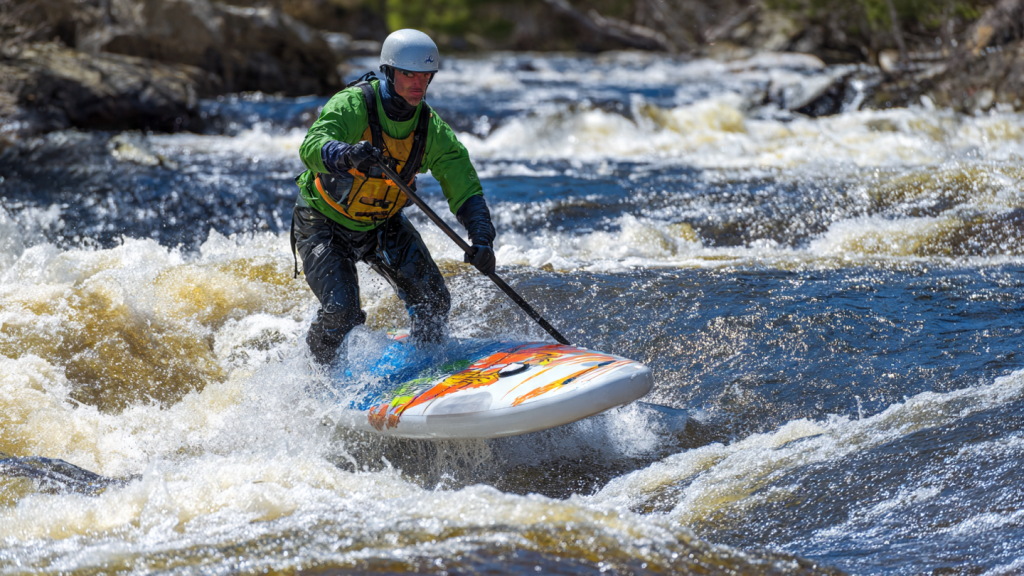
A whitewater paddle board is a specially designed stand-up paddle board (SUP) made for riding rivers, rapids, and moving water. Unlike regular paddle boards used on lakes or calm seas, whitewater SUPs are built to handle rough conditions and impacts with rocks.
Key Features
- Inflatable Construction: Most whitewater paddle boards are inflatable because they are more durable and safer when hitting obstacles.
- High Stability: They are wider and thicker than many touring or racing boards, making them easier to balance on turbulent water.
- Durable Materials: Reinforced PVC and multiple layers help resist punctures and abrasion.
- River-Specific Fins: Shorter, flexible fins reduce the risk of damage in shallow rivers.
- Attachment Points: D-rings and deck rigging allow paddlers to secure gear or safety equipment.
- Non-Slip Deck Pad: Provides extra grip when standing in wet conditions.
Typical Dimensions
- Length: 8–11 feet (2.4–3.4 meters)
- Width: 34–40 inches (86–102 cm)
- Thickness: 5–6 inches (13–15 cm)
Essential gear you can’t skip
- Helmet: Kayak/whitewater rated. Rocks are unforgiving.
- PFD: Type V rescue vest with quick-release belt for your leash. Standard SUP PFDs won’t cut it.
- Quick-release leash: Goes on your waist belt, NOT your ankle. Ankle leash in moving water = foot entrapment death trap. Must release under load.
- Paddle: Strong carbon or fiberglass shaft, plastic blade. Expect to beat it on rocks. Adjustable length helps. Usually 6″–8″ taller than you.
- Footwear: Sticky-soled river shoes or booties. Protects feet, grips wet rocks.
- Protection: Knee pads and elbow pads are common. Shin guards if it’s rocky.
- Drysuit/wetsuit: Water temp dependent. Hypothermia is real even in summer snowmelt.
Skills you need before hitting Class II+
- River reading: Identify eddies, eddy lines, waves, holes, strainers, pour-overs. If you can’t see the hazards, you can’t avoid them.
- Bracing: Low brace and high brace to avoid falling. Your paddle is your third leg.
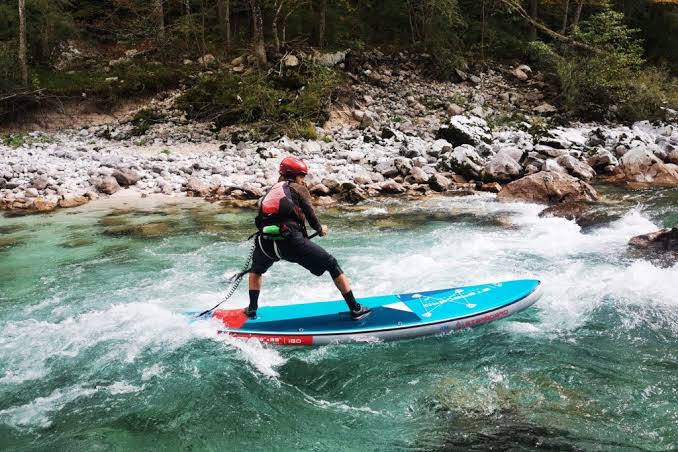
- Stance switching: Surf stance with feet offset, knees bent, looking downstream. Switch stance fast to face obstacles.
- Falling safely: Fall flat to the side, away from the board. Never fall standing up — foot entrapment risk. Keep feet up and pointed downstream if you swim.
- Self-rescue: Flip your board, climb back on in moving water. Swim aggressively to eddies.
- Ferrying & peel-outs: Use the current to move laterally across the river and to enter/exit eddies
Key risks & how to manage them
Pinning: Board wraps on rock. Rule: Let go of the board if needed. Boards are replaceable.
Strainers: Trees/branches that let water through but not you. Rule: Never go where you can’t see the exit.
Foot entrapment: Foot gets stuck between rocks, current pushes you down. Rule: Never stand up in moving water if you fall. Swim defensive.
Leash entanglement: Wrong leash can drown you. Rule: Quick-release on waist only.
Flush drowning: Long swims in cold water = exhaustion. Rule: Paddle with crew, know your limits, dress for immersion.
Uses
Whitewater river paddling
Rapids and fast-moving water
River surfing
Adventure and expedition trips
Skill Level
Whitewater paddle boarding is generally considered an intermediate to advanced SUP activity because it requires strong balance, river-reading skills, and knowledge of water safety.
In simple terms, a whitewater paddle board is a rugged, highly stable SUP designed specifically for navigating rivers and rapids safely.